












Is Your Tongue Coated? What Your "Morning Tongue" Says About Your Agni
A coated tongue in the morning usually means your Agni, your digestive fire, is running weak. In Ayurveda, a thick white or yellow layer when you wake up is a sign of Ama. That's the waste left behind when food doesn't get fully digested.
Modern research is starting to look at the same link between the tongue and the gut. One study compared 78 people with gastritis to 50 healthy people and found that the bacteria in their tongue coating were different. It identified 21 bacterial species that could tell the two groups apart. Another study found that the bacteria in the tongue coating closely matched the bacteria in the stomach fluid of gastritis patients.
This guide covers what a coated tongue means in Ayurveda, the most common coated tongue causes, how to read your tongue each morning and how to stop the coating from coming back.
What Is a Coated Tongue?
A coated tongue has a film of white, yellow, grey or brown on top. Your tongue is covered in tiny bumps called papillae. When they swell or overgrow, debris, bacteria and dead cells get stuck between them, and the tongue looks coated.
A thin, clear film that comes off with one or two scrapes is normal after sleep. A thick, sticky layer that comes back every morning is the one to pay attention to.
What Is Agni in Ayurveda?
Agni is the fire in your body that breaks food down and turns it into energy, tissue and strength. Ayurveda places it at the centre of good health.
When Agni is strong, food gets fully digested, and very little waste is left. When Agni is weak, food sits in the gut and ferments. It turns into Ama, a heavy, sticky residue.
Ayurveda describes four states of Agni, and each one tends to show up on the tongue in its own way:
- Sama Agni (balanced): You get hungry at regular times and feel light after meals. Your tongue is clean and pink.
- Manda Agni (slow): You feel heavy, have little appetite in the morning and feel sleepy after meals. Your tongue has a thick white coat.
- Tikshna Agni (too sharp): You get famished, with acidity and a burning feeling. Your tongue has a yellowish coat or a red tip.
- Vishama Agni (irregular): Your hunger comes and goes, and you have gas, bloating, and constipation. Your tongue is dry, often cracked, with a thin grey or brown coat.
Why Ama Shows Up on Your Tongue in the Morning?
Your tongue is the first part of your digestive tract. In Ayurveda, your digestive system stays awake while you sleep. It clears waste overnight and leaves some of it on the surface of your tongue. That's why the coating is thickest when you wake up and why it usually sits at the back.
A coated tongue rarely comes alone. You may also notice:
- Feeling tired even after a full night's sleep
- Bad breath that comes back soon after brushing
- No appetite for breakfast
- A heavy body and stiff joints in the morning
- A dull or sticky taste in the mouth
Research by Zandu Care backs up the tiredness link. Nearly 3 in 4 people with a poor gut health score said they felt tired or sleepy when they woke up.
Common Coated Tongue Causes
A coated tongue can result from weak digestion, everyday habits, or, less often, a health condition. Ayurveda and modern medicine each explain it a little differently.
Causes According to Ayurveda
Ayurveda links a coated tongue to habits that slow Agni down:
- Eating a heavy dinner or eating late at night
- Eating when you're not really hungry, or snacking all day
- Drinking ice-cold water or cold drinks with meals
- Eating a lot of fried, processed or leftover food
- Irregular meal times, poor sleep and stress
Medical Causes
Doctors point to more everyday reasons:
- Not cleaning the mouth and tongue properly
- Dehydration
- Breathing through the mouth
- Smoking or chewing tobacco
- A low-fibre diet of mostly soft or mashed food
- Irritation from sharp teeth, dental appliances or dentures
- Drinking more than one alcoholic drink a day
- Taking antibiotics
- Dry mouth from medicines or illness
Occasionally, a white coating on the tongue points to a health condition. These include oral thrush (a Candida yeast infection), leukoplakia, oral lichen planus, geographic tongue and syphilis.
What Is Tongue Diagnosis in Ayurveda?
Tongue diagnosis in Ayurveda is called Jihva Pariksha. It's one part of Ashtavidha Pariksha, the classical eightfold examination. It looks at the tongue's colour, its shape, where the coating sits, the coating itself and how the tongue moves.
The other seven parts of Ashtavidha Pariksha are pulse, urine, stool, voice, touch, eyes and overall appearance.
What the Coating Colour Means
- White, thick, moist or mucousy: Kapha imbalance. This condition often goes with slow Agni.
- Yellow, green or greasy: Pitta imbalance, meaning too much heat in the system.
- Grey, brown, black or dry: Vata imbalance.
A thin white film that scrapes off fully is considered normal.
Where the Coating Sits
Ayurveda divides the tongue into three zones:
- Back (Vata zone): intestines, colon and kidneys
- Middle (Pitta zone): stomach, liver, pancreas and spleen
- Front and tip (Kapha zone): heart and lungs
If the whole tongue is coated, Ayurveda reads the condition as toxins that have spread through the bloodstream.
Tongue Colour and Shape
- Pink: This is a healthy colour.
- Pale or whitish: Kapha imbalance. A pale tongue that lasts can also be linked to low iron, so mention it to a doctor.
- Red tip or red spots: Pitta, meaning heat. It often follows spicy food, alcohol or stress.
- Cracks and dryness: Vata. A single line down the middle is common and usually harmless.
- Teeth marks along the edges: Weak digestion or fluid retention. It can also come from clenching your jaw.
- Swollen or puffy: Kapha.
Movement
A tongue that shakes, moves side to side, or can't stick out easily is read as a Vata imbalance.
Quick Tongue Reference Table
|
What you see |
Ayurveda links it to |
What to check |
|
Thin, clear film |
Balanced Agni |
Usually normal |
|
Thick white coat at the back |
Ama, slow Agni (Kapha) |
Late or heavy dinners |
|
Yellow, greasy coat |
Excess heat (Pitta) |
Spicy, oily food, alcohol |
|
Grey or brown dry coat |
Vata imbalance |
Water intake, irregular meals |
|
Red tip |
Pitta |
Stress, spice |
|
Cracks |
Vata |
Sleep, hydration |
|
Teeth marks |
Weak digestion |
Meal timing, jaw clenching |
|
Smooth, glossy, very pale |
Outside Ayurveda |
See a doctor |
How to Check Your Tongue Every Morning?
The best time to check your tongue is right after you wake up. It takes about 10 seconds:
- Check before you brush, scrape, drink or eat anything. All of these change how the tongue looks.
- Stand in natural light if you can. A yellow bulb can hide the colour.
- Stick your tongue out gently. Don't strain or hold it out too long, because that makes it turn red.
- Look at three things: the coating, the colour underneath and the shape.
One odd morning doesn't mean much. Note what you see for a week. A pattern tells you more than a single day.
Going Daily Doesn't Mean Your Gut Is Fine
Many people assume their digestion is fine because they go to the bathroom every day. Zandu Care's research suggests that isn't always true.
Among people who go every day, nearly 1 in 2 still struggle to complete a bowel movement. More than half still feel full sitting in their stomach hours after eating. In Ayurveda, that heavy, "food is still there" feeling is a classic sign of slow Agni and Ama, and so is a coated tongue the next morning.
Ayurvedic Support Based on What Your Tongue Shows

Daily habits come first. If your tongue and your gut keep giving the same signal for weeks, Zandu Care's Good Gut range has an option for each pattern.
Thick White Coat, Heavy and Sluggish Gut
This is the classic Ama picture: heavy mornings, bloating, gas and a feeling that digestion is "off". Zandu Good Gut Cleanse & Detox Shots are made for this kind of everyday, lifestyle-led heaviness.
- Made with 35 Ayurvedic herbs, mainly Lavang, Triphala, Ajwain and Draksha
- Fermented using the traditional Ayurvedic Arishta process, with prebiotics and postbiotics
- In Zandu's clinical testing, 89% of people felt less bloating, and 87% got relief from constipation
- How to take it: 1 shot twice a day, as a 45-day course
Yellow Coat or Red Tip with Acidity
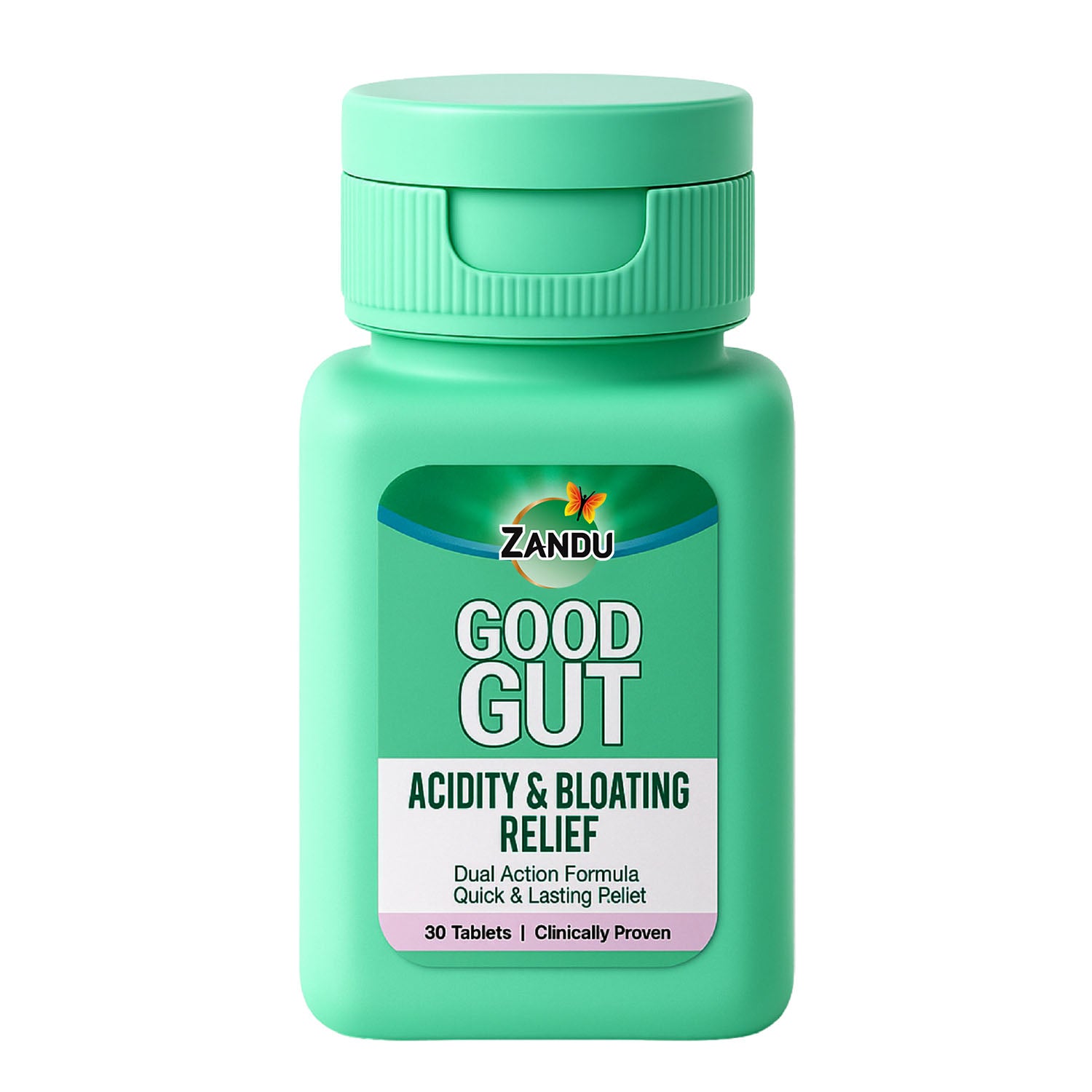
A yellow coat or red tip, along with burning, sour burps or reflux after tea, coffee or spicy food, points to too much heat (Pitta). Zandu Good Gut Acidity & Bloating Relief Tablets are made for these acidity episodes.
- A two-layer tablet with Muktashukti Bhasma for quick acidity relief and GutGard Yashti for long-term gut support
- 95% of users felt fewer acid burps and less reflux
- Not habit-forming
- How to take it: 1 tablet before lunch and 1 before dinner
Coat at the Back with Constipation
A coating at the back of the tongue is linked to the intestines and colon. If it comes with hard stools, straining or going a day or two without a bowel movement, Zandu Good Gut Constipation Relief Tablets can help.
- Made with 8 Ayurvedic herbs, including Triphala, Haritaki, Svarnapatri and Eranda Tail
- 93% of users felt relief from the first dose
- Works overnight and isn't habit-forming
- How to take it: 1 tablet at bedtime
Check with a doctor or Ayurvedic practitioner before starting any supplement, especially if you're on medicines or have a health condition.
When a Coated Tongue Needs a Doctor

A white tongue is usually harmless and goes away on its own. See a doctor or dentist if it lasts longer than a few weeks, if your tongue hurts, or if you're worried about changes in your tongue.
Also get checked if:
- White or red patches don't come off when you scrape
- You have a lump, an ulcer, bleeding or numbness
- It's hard to swallow
- Your tongue is smooth, sore or very pale
- You use tobacco or drink heavily and notice any change
A morning tongue check is a habit for getting to know your body. It doesn't replace a medical test.
The Bottom Line
Your tongue gives you a free health check every morning. A clean, pink tongue means your Agni is doing its job. A thick, sticky coat means food isn't fully digesting, and Ama is building up.
Check your tongue before brushing, scrape it gently and work on the habits that keep your digestive fire strong. If the coating stays for weeks or comes with pain, see a doctor.
References
The studies, research and medical sources used in this article are listed below.
- Cui J, et al. Tongue coating microbiome as a potential biomarker for gastritis, including precancerous cascade. Protein & Cell, 2019. https://academic.oup.com/proteincell/article/10/7/496/6759321
- Species composition and overall diversity are significantly correlated between the tongue coating and gastric fluid microbiomes in gastritis patients. BMC Medical Genomics, 2022. https://pmc.ncbi.nlm.nih.gov/articles/PMC8932003
- Choi HN, Cho YS, Koo JW. The effect of mechanical tongue cleaning on oral malodour and tongue coating. International Journal of Environmental Research and Public Health, 2021. https://pubmed.ncbi.nlm.nih.gov/35010368
- Tongue scraping for treating halitosis. Cochrane Database of Systematic Reviews, 2006. https://pubmed.ncbi.nlm.nih.gov/16625641
- Tongue scrapers may reduce halitosis in adults. Evidence-Based Dentistry, 2006. https://www.nature.com/articles/6400433
- Timmesfeld N, et al. Mechanical tongue cleaning is a worthwhile procedure to improve the taste sensation. Journal of Oral Rehabilitation, 2021. https://pubmed.ncbi.nlm.nih.gov/32978806
- Impact of tongue cleansers on microbial load and taste. https://pubmed.ncbi.nlm.nih.gov/15191584/
- Mayo Clinic. White tongue: Causes. https://www.mayoclinic.org/symptoms/white-tongue/basics/causes/sym-20050676
- Cleveland Clinic. White tongue: Causes, treatments and prevention. https://my.clevelandclinic.org/health/symptoms/17654-white-tongue
- Zandu Care. Gut health consumer research (in-house survey).
- Zandu Good Gut Cleanse & Detox Shots. https://zanducare.com/products/zandu-good-gut-detox-shots
- Zandu Good Gut Acidity & Bloating Relief Tablets. https://zanducare.com/products/good-gut-acidity-bloating-relief-tablets
- Zandu Good Gut Constipation Relief Tablets. https://zanducare.com/products/constipation-relief-tablets
Written by

Zanducare
India’s trusted name in Ayurvedic wellness, offering time-tested solutions for today’s health and lifestyle needs. With formulations rooted in classical Ayurvedic texts and crafted using pure natural ingredients, we bring holistic care into your everyday routine.
Research by




Leave a comment
This site is protected by hCaptcha and the hCaptcha Privacy Policy and Terms of Service apply.